
Airflow mystery solved at America’s Underground Lab
An engineering team at SURF monitoring air flow through 370 miles of tunnels and shafts did not understand why underground air patterns changed during times of heavy rain. The solution was just published in the journal of Mining, Metallurgy & Exploration.
Successfully operating in a deep underground space requires the mitigation of two factors: air and water.
Adequate airflow is needed for workers to survive in the tunnels and shafts far below the surface. Additionally, water that percolates down from rainfall or that flows in at any intersections to aquifers must be pumped out.
Large underground operations, like mines, often have whole teams of engineers and technicians that specialize in air and water flow. This is also true for a scientific laboratory like the Sanford Underground Research Facility (SURF). Mining does not occur at SURF today, but mining engineers are still vital for the safe operation of underground tunnels and shafts that make up the vast facility.
At SURF, the ventilation system is led by Jason Connot, a mining engineer who has worked at the facility since 2019. Connot and others noticed something strange about underground airflow patterns during periods of heavy rain—sometimes they moved backwards.
“We noticed our fan would go haywire at 5 Shaft. Some areas would show reduced or even reversed airflow during large rain events,” Connot said.
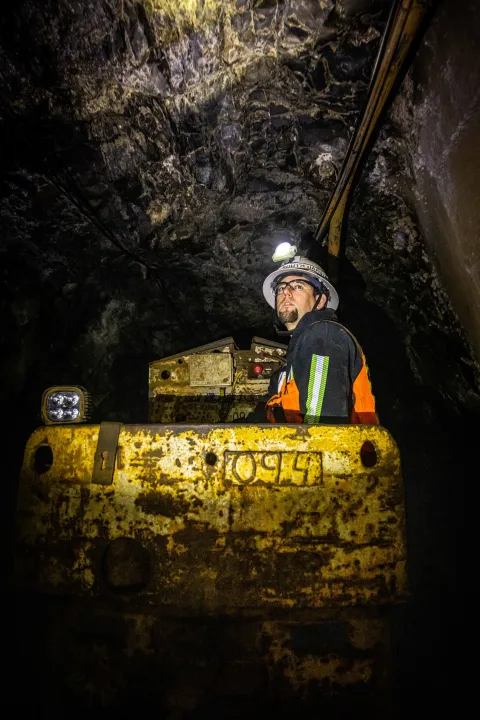
Jason Connot on the 1700 Level in 2026 running an underground locomotive.
Photo by Stephen Kenny
At SURF air primarily enters two main shafts and is ventilated out through two separate shafts. 5 Shaft, normally exhaust air—except in cases of heavy rain where water is discharged down into to the deep pool through 5 Shaft.
“At first, we didn’t know what was going on with the airflow in large rain events,” Connot said. “We could all see these airflow changes occurring throughout the underground, and we were like, why is this happening?”
Engineers survive on data-driven decisions; Connot and the team didn’t have the data they needed to solve the problem until Maestro air flow sensors were installed on the 2000 Level to control an automated regulator.
Prior to this, a set of airflow sensors installed by Steve Gabriel a Spearfish Highschool science teacher and his class first captured an event on the 4850L during a test of the shaft deluge system. “We felt that airflow increase on the 4850 Level during that test. That's what made the correlation and triggered everything,” Connot said. Gabriel led his students to build and deploy a series of air flow monitors at SURF, before joining the team at the facility as a full-time ventilation technician.
In heavy rain, inflows can overwhelm the underground water pumping system, so engineers divert extra water down 5 Shaft to the deep pool, later to be pumped out. This process is kind of like an overflow spillway for a dam that gets too full. The team hypothesized that extra water falling down 5 Shaft was acting kind of like a syringe pushing fluid down into a needle.
But they needed proof.
Connot did some digging and found a few references in the scientific literature documenting this same phenomenon in large municipal sewer systems. The literature included some math on the fluid dynamics of these unique conditions. Connot and team members from South Dakota Mines modified the equations to fit SURF’s conditions, and the math lined up.
“When we added our numbers and parameters to the model, everything came out spot on, Connot said. “You would not think the weight of water droplets could move so much air.”
This finding has implications for a range of underground operations worldwide, and not just for high rain events.
“If there's ever a fire, mining engineers will sometimes turn a valve on up top and just dump water down the shaft. Knowing this can change the air flow is critical information for everyone. We tested this, we've seen it occur,” Connot said.
Because SURF is a dedicated science and engineering research facility, Connot and the engineering team had the time to study and understand this problem. “This is not the kind of study you’d always have time to do in an operational mine,” Connot noted.
Bryce Pietzyk agrees. Pietzyk is the director of underground operations at SURF.
“One thing I really like about working with Jason is he really wants to dive into the kind of details needed to understand complex operations systems such as this. No one had previously taken the time to grasp this issue—but it's absolutely critical, and that’s why the whole team supported this study,” Pietzyk said. “Thanks to this work, we're able to be way ahead of airflow issues, predict what will happen, and configure ventilation controls in the right manner.”
Connot’s research paper, Effects of Water Inflows on a Mine Ventilation System: A Case Study is published in Mining, Metallurgy & Exploration, DOI 10.1007/s42461-026-01586-0:.
Dr. Andrea Brickey is Connot’s advisor and a professor in the Department of Mining Engineering and Management at South Dakota Mines. “As an advisor, one couldn’t ask for a better graduate student than Jason,” Brickey said. “He identified a phenomenon impacting ventilation systems and his curiosity drove him to want to determine how to predict that behavior. He succeeded, and his work is helping SURF and an entire industry.”
Pietzyk gives additional praise to Connot for completing this master’s thesis on top of his normal job at SURF.
“Jason is an engineer who goes above and beyond,” Pietzyk said. “The work he did to complete this research shows he really cares about this facility. He kept it all together while doing his full-time engineering job, commuting from Rapid City, completing his Master’s Degree, and raising a family. He deserves credit for this, it’s really an amazing effort.”
-
Photo by Mathew Kapust
-
Photo by Matthew Kapust


