
Building the quantum workforce: Workshop at SURF explores the future of next generation technology
The Institute for Underground Science at SURF recently hosted the third annual Quantum Partnership Workshop, a collaborative gathering of researchers and partners engaged in the quantum ecosystem.
History is full of examples of disruptive technology. The Luddites of the 19th century rebelled against the Industrial Revolution and the use of machines to lower wages, bypass labor standards, and destroy their livelihoods.
They broke into factories at night and smashed looms with sledgehammers, spurring a major government crackdown. It took more than a century to see the creation of new labor laws, such as minimum wage, child labor standards, and a 40-hour workweek.
This history seems important to reflect on today.
“Quantum technologies, including computing, networking, basic quantum science, are going to be the drivers for the next phase of technological change,” said Mickey Slimp, executive director of the Great Plains Network.
Making way for a quantum future and building regional networks to leverage its potential were key topics at the third annual Quantum Partnership Workshop, held at the Sanford Underground Research Facility (SURF) this summer. The annual workshop is hosted by the Great Plains Network (GPN) and the Institute for Underground Science at SURF, in partnership with the South Dakota Quantum Center. The collaborative gathering sought to advance quantum science, technology, and networking while expanding education and workforce development efforts.
The emergence of quantum technology, alongside ongoing advancements in AI, has the potential to revolutionize a broad range of industries, including medicine, energy and cybersecurity.
Eden Figueroa from Stony Brook University and the Brookhaven National Lab led a virtual discussion during the workshop on the latest in quantum networking technologies. The challenges in building quantum infrastructure and a quantum internet poses both unique challenges and opportunities for the future.
It’s true that the quantum future relies on technological advancements in networking and computing. It’s also true that the quantum workforce of tomorrow is not just people with Ph.D.’s. doing cutting edge research. There is room for all.
“I think one of the biggest myths about quantum is that people aren't already empowered with the right skill sets,” said Emily Easton, the director of education and workforce development at the Chicago Quantum Exchange and keynote speaker at the workshop. “Welders, pipe fitters, mechanical engineers—all of these are examples of roles that include valuable skill sets that easily transition into quantum. So even if someone doesn't have a quantum-focused degree or background, they're still incredibly useful in a range of roles.”
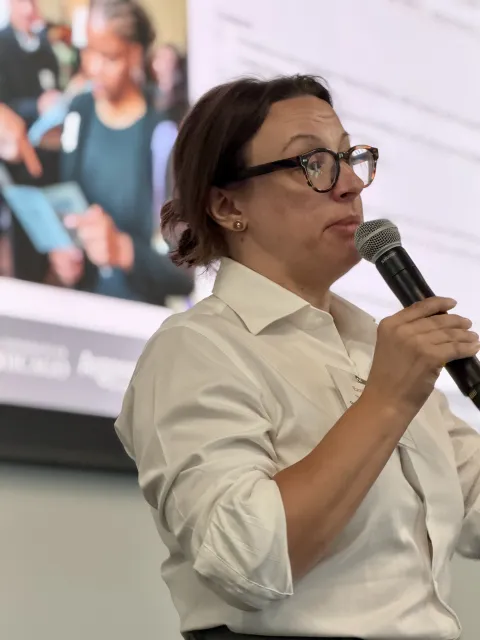
Dr. Emily Easton, the director of education and workforce development at the Chicago Quantum Exchange speaks at SURF during the Quantum Partnership Workshop.
One of Easton’s core messages to those working to develop and push the boundaries of quantum is that preparing the workforce of tomorrow is just as important as advancing technological breakthroughs.
“We know that this technology is coming which means now is the time for ecosystems to start thinking about all of the different assets they have—including those that are perhaps less obvious,” Easton said. “This is also a good time to explore how those assets integrate with each other and with the assets of other ecosystems. Quantum is inherently interdisciplinary and the way that we approach the research, commercialization, and workforce preparation needs to be similarly multifaceted.”
The future quantum economy does not have to be centered only on the coasts and in places like Silicon Valley. The focus of the Great Plains Network (GPN) is to see the Midwest both benefit from and prepare for the future of this technology. Slimp points out that this effort is already underway with multiple organizations, universities and institutions.
“We have a lot of activities dealing with quantum throughout the Midwest,” Slimp said. “It's just never been pulled together, and so when I looked at National Science Foundation funding, we had over 200 projects in the past 15 years in the Midwest that included some aspect of quantum physics, quantum computing or other quantum sensing. GPN is pulling together the states in this region to give us a core of resources and people to really have an impact on all of this.”
For Easton, this kind of organization and networking is essential ahead of the coming changes.
“No one organization or discipline is prepared to do all the things we need to do to scale up in quantum. That's why it's so important we're building those networks and connections now, so we can draw on those resources as they come,” Easton said.
She points out that South Dakota has a history of recognizing the massive returns investment in future technology can bring.
“South Dakota, I think, is already a great example of a technology center that is using what it has to deliver results in new ways. For example, repurposing a gold mine into an underground research facility is genius. How can we find other synergies that leverage existing assets to ensure that South Dakota is included in the economic and workforce benefits we know are coming with quantum?” Easton said.
Institutions in South Dakota are already leading the way for the rest of the state. The Quantum Partnership Workshop spent the last day at South Dakota Mines in the Department of Nanoscience & Biomedical Engineering. Department head and professor Steve Smith explained his team’s investigation of the optical and electronic properties of quantum nanomaterials. Both South Dakota Mines and Dakota State University in Madison have been key players in the South Dakota Quantum Center and in ongoing cutting-edge research around the country.
For her part, Easton applauds the ongoing efforts across the state and at SURF.
“These types of national laboratory settings are ideal sites for these collaborations because they bring together that interdisciplinary research, but also provide the outreach piece, the workforce piece, the public engagement piece, to help universities, schools, community colleges, individual efforts come together. I think there's a real role for SURF specifically to play in the quantum economy in South Dakota,” she said.
Quantum technology in both computing and sensing has huge benefits and opportunities for SURF as well. Physics has always been on the cutting edge of new computing technology and applications. Simultaneous preparation for the quantum economy, through robust outreach, education, and workforce development efforts, can expand opportunities to broad swaths of the public and help avoid any repeat of the 19th-century Luddite uprising.
The Institute for Underground Science at SURF is already in planning for next year’s Quantum Partnership Workshop. Save the date for July 27–30, 2027.


