
Present
LUX-ZEPLIN
LUX-ZEPLIN (LZ) is an international collaboration of ~250 scientists and engineers from 39 institutions. The detector is managed by the U.S. Department of Energy’s Lawrence Berkeley National Laboratory (Berkeley Lab) and operates nearly one mile below ground (1.5 km) at SURF. The experiment uses 10 tonnes of ultrapure liquid xenon to search for dark matter and is optimized to look for WIMPs, or weakly interacting massive particles.

What is Dark Matter?
For many, dark matter is a hard concept to grasp, and for good reason; it’s invisible in everyday life, undetectable in every normal sense. But for physicists and astronomers—who peer into the depths of the universe—there is strong evidence for its existence.
That evidence is in the math. Galileo postulated that math is the language of the universe, and the math is not working out. The spiral galaxies we see in the universe are moving in ways that indicate a huge amount of extra mass out there that we cannot see.
Imagine if a feather floating in the wind, landed on a rowboat and suddenly caused it to sink into the pond. This analogy, while not perfect, is similar to the mystery in the motion of some celestial bodies, and scientists think dark matter is the most likely candidate to explain the missing mass and movement of spiral galaxies.
Have we found Dark Matter?
Maybe.
The LUX-ZEPLIN experiment observed a particle interaction that could be interpreted as a signal from WIMPs, a dark matter candidate—but researchers will need more data to confirm.
The result isn’t a discovery, but is the most compelling hint of dark matter reported by the experiment to date. LZ continues to run to see if additional data strengthens or weakens the hint of a dark matter interaction.
Read more about this potential discovery here.
“We’re very intrigued to see this event in the data, in the region where we expect dark matter to show up and the competing backgrounds are very low,” said Rick Gaitskell, a professor at Brown University and the spokesperson for LZ. “With only one event, we don’t want to get ahead of ourselves. We are not claiming to have seen dark matter. But we have seen something interesting that we want to share with the scientific community for their input.”
What are WIMPs?
WIMPs (weakly interacting massive particles) are among the top prospects for explaining dark matter.
Unseen, because it does not emit, absorb, or scatter light, dark matter’s presence and gravitational pull are nonetheless fundamental to our understanding of the universe. For example, the presence of dark matter, estimated to be about 85 percent of the total mass of the universe, shapes the form and movement of galaxies, and it is invoked by researchers to explain what is known about the large-scale structure and expansion of the universe. This “missing mass” is considered to be one of the most pressing questions in particle physics.
How does the experiment work?
Operating the world’s leading dark matter experiment, LZ, in a deep underground environment is no small task. (See more in this video.)
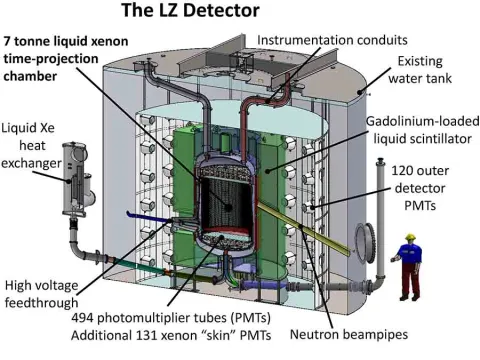
In the simplest sense LZ is designed like an onion with several layers surrounding a core that holds 10 metric tons of liquid xenon (7 active tonnes). Researchers believe some of the particles of dark matter streaming through every square inch of the universe will interact with some of the xenon atoms. You can think of this interaction like two pool balls colliding. When this reaction happens, it will create a tiny flash of light at the center of the xenon chamber, indicating dark matter.
View more on the LZ Dark Matter Experiment website here.
The LZ Spectator website is another example of that shows the detector in operation.
“SURF is extremely proud to host world-leading science like LZ. The strong partnership we have with Berkeley Lab and the LZ collaboration is a shining example of how to foster the very best science in the world and delve into some of the greatest mysteries in the Universe.”

~250 scientists from 39 institutions
Scientists from around the world come to SURF to work on the LUX-ZEPLIN dark matter experiment.
-160 Degrees
In the search for WIMPs, scientists with LZ use 10 metric tons of super dense liquid xenon, which is cooled by liquid nitrogen to -160 Fahrenheit.
Impact
LZ has made major impacts to the understanding of dark matter.

The Team at SURF
LZ is maintained by a talented team of scientists, engineers, technicians, and students whose tireless labor keeps the experiment running on the 4850 Level of SURF. See more in this video on LZ.
-

Alex Geffre, an engineering technician at SURF, at work on LZ.
Photo by Stephen Kenny
-
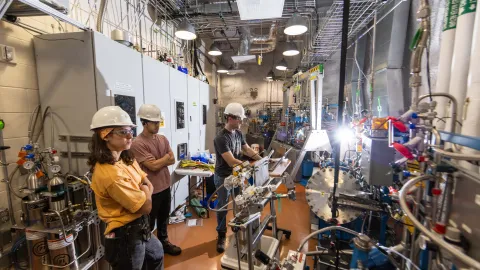
Scientists working on LZ are shown here alongside some of the equipment they maintain.
Photo by Stephen Kenny
-
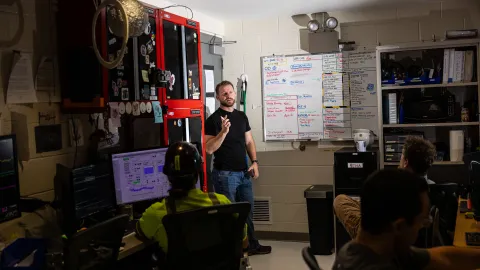
Gavin Cox, an experiment support scientist at SURF, confers with the team inside the LZ Control Room on the 4850 Level Davis Campus.
Photo by Stephen Kenny
-
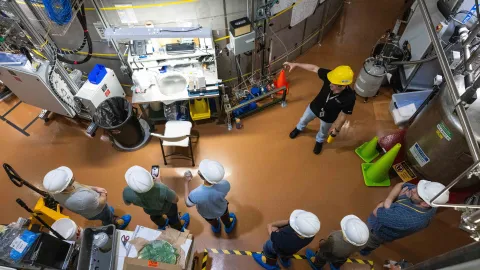
Markus Horn gives a tour of LZ to visiting scientists.
Photo by Stephen Kenny
-
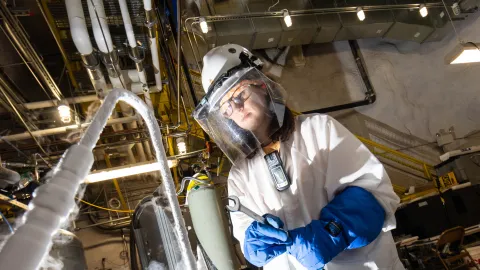
Olivia Valentino, a Ph.D. student studying particle physics at Imperial College London, is among the graduate students who have visited SURF to work on LUX ZEPLIN (LZ), the leading dark matter experiment on the planet.
Photo by Stephen Kenny
-
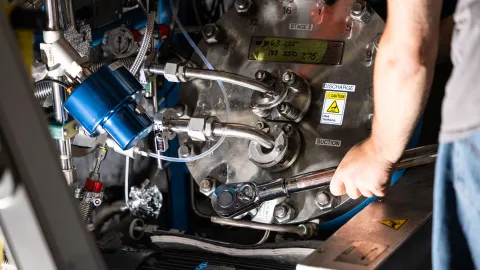
Xenon compressor maintenance is a vital part of the success of LZ.
Photo by Stephen Kenny
-
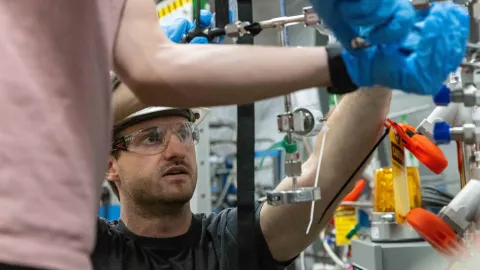
Gavin Cox, a physicist and experiment support scientist at SURF, helps complete one of many hands-on tasks required to keep LZ operational.
Photo by Stephen Kenny
-
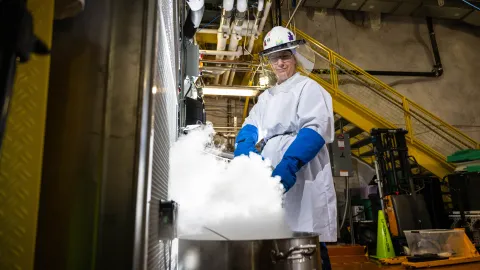
Julia Delgaudio, an experiment support scientist at SURF, works on the cryogenic system for LZ.
Photo by Stephen Kenny
-

Dr. Douglas Tiedt, a research scientist at SURF, at work on LZ inside the Davis Cavern.
Photo by Stephen Kenny
-
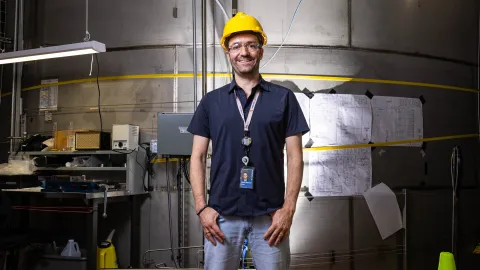
Dr. Markus Horn, a senior research scientist at SURF, stands in front of the LZ detector.
Photo by Stephen Kenny


Collaboration and Support
The South Dakota Science and Technology Authority, which manages SURF through a cooperative agreement with the U.S. Department of Energy, secured 80 percent of the xenon in LZ. Funding came from the South Dakota Governor’s office, the South Dakota Community Foundation, the South Dakota State University Foundation, and the University of South Dakota Foundation.
LZ is supported by the U.S. Department of Energy, Office of Science, Office of High Energy and Nuclear Physics, and the National Energy Research Scientific Computing Center, a DOE Office of Science user facility. LZ is also supported by the Science & Technology Facilities Council of the United Kingdom; the Portuguese Foundation for Science and Technology; the Swiss National Science Foundation; the Australian Research Council Centre of Excellence for Dark Matter Particle Physics; and the Institute for Basic Science, Korea. Thirty-nine institutions of higher education and advanced research provided support to LZ. See the full list of collaborators here.

