
Aiming at number 9: CASPAR targets fluorine in new science run
The Compact Accelerator System for Performing Astrophysical Research (CASPAR) recreates conditions inside stars to study how elements are made. The experiment recently restarted with a new target: No. 9 on the atomic scale, fluorine.
If you're like most of us, fluorine doesn't come to mind all that often. The ninth element on the periodic table sits largely unnoticed between oxygen and neon. In a nutshell, you can't breathe fluorine, and it doesn't light up the beer sign at your favorite watering hole.
But if you happen to geek out on a subject like stellar nucleosynthesis—the study of how stars form elements—fluorine turns into a total rock star.
“What I find most interesting about fluorine is that we think the reaction that created this element took place inside stars pretty early on in the universe,” said Leah Zimmer, a Ph.D. candidate in physics at the University of Notre Dame who is using CASPAR to study how fluorine is formed in early stars. “We're really interested in studying interactions with fluorine, as it can be a piece of the puzzle as to how the first stars were formed way back in the early universe.”
Elements are forged by the intense heat and pressure inside stars that smashes together protons and neutrons in fusion reactions. Elements with the smallest atomic numbers, like hydrogen and helium, form the first building blocks in the sequence. As more protons and neutrons are added inside the cosmic cauldrons, the atomic numbers increase to form heavier elements.
CASPAR can mimic these stellar reactions. The small particle accelerator is located nearly a mile underground at Sanford Underground Research Facility (SURF). It can smash protons into specialized targets to recreate the kinds of conditions that form elements like fluorine.
“CASPAR helps us better understand the stellar environment, what elements are produced, how are they produced, what energy do they produce while forming, and in what conditions can we recreate that we can kind of give information about the insides of stars,” said Dan Robertson, the principal investigator on CASPAR and a research professor in the Department of Physics & Astronomy at the University of Notre Dame.
Fluorine, it turns out, is a key building block in the process. Once in a while, an interaction with fluorine will help elemental production escape a cycle of elements that some stars get stuck in. In these cases, carbon, nitrogen and oxygen are repeatedly produced and then destroyed. This process, called the CNO cycle, can stop the formation of heavier elements.
“But fluorine is one of these breakout reactions that, in certain conditions, can jump from carbon, nitrogen, oxygen, bam, straight through fluorine and on to the heavier elements,” Robertson said.
Even with a working particle accelerator sitting in an underground lab, recreating the environment where fluorine is formed is much easier said than done. As part of her Ph.D. research, Zimmer had to make the fluorine-based target for the accelerator to hit. This process involved a year and a half of trial and error, thousands of runs inside a surface accelerator, and even preparing samples with hydrofluoric acid.
“I find the hands-on stuff really interesting. There is a lot of joy to doing something where you can see the results of what you've done,” Zimmer said. “In making the targets, I've been able to go through the whole process from starting with the sheets of metal to going into the testing phase, cutting everything down to size, cleaning it, just learning all these steps and techniques. Then combining that side of it with running the accelerators themselves. It's just such a unique opportunity.”
CASPAR can recreate this unique opportunity for students again and again. Part of the experiment's goals is to educate the next generation of astrophysicists and nuclear physicists.
“One of the nice things about CASPAR is we can self-contain these modules for graduate students to get the full experience, whether they like it or not,” Robertson said with a laugh. “Students like Leah get to do everything from mechanical engineering, chemistry, materials science, and even—turning wrenches as a grease monkey—all the way to astrophysics, data analysis, computational management, and scientific publication.”
For students, the tedious hours spent inside a laboratory just preparing samples or analyzing data can pay off in the results. An improved understanding of how elements form in stars yields better astrophysics.
“This work does have an impact, even if it's a tiny little impact on the astrophysics community. To realize this is something that someone might actually use for something someday, I just think it's both interesting and rewarding,” Zimmer said.
Theorists use both astronomical observations and experimental data to drive the science forward. CASPAR lives in a symbiotic relationship with the most powerful telescopes ever created. The work underground at SURF by researchers like Zimmer can yield new insights into the data and images gathered from the very early universe—the first stars and galaxies.
“Basically, it's like three legs of a stool. Observation, experiment and theory all work together and support each other,” Robertson said.
Astronomers using telescopes like the James Webb Space Telescope have noticed amounts of some of the heavier elements, like calcium, in higher concentrations than current models can predict in early stars. For experimentalists like Zimmer, this offers an opportunity to fill in a gap in understanding.
“And so, if in studying this, I find that the fluorine reaction is a little bit stronger than what the current model is saying, then that could lead to a higher rate of calcium you would have expected to see, and that'll give some insight into what is going on in those stars,” Zimmer said.
Fluorine is element No. 9 — there are 109 heavier elements on the periodic table. Not all of them have the same complexity in their formation, but with so much to learn on this subject CASPAR has no shortage of work in the coming years to unravel processes that made the elements— and, in turn, made us all.
-
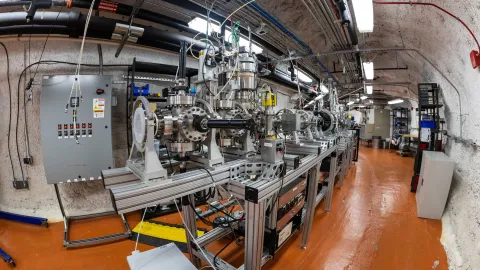
Photo by Stephen Kenny
-
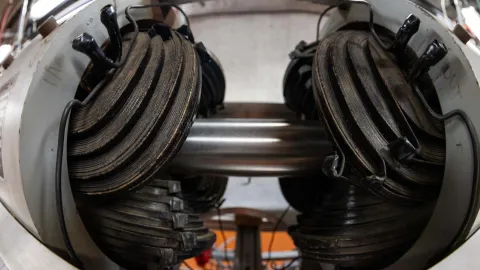
Photo by Stephen Kenny
-
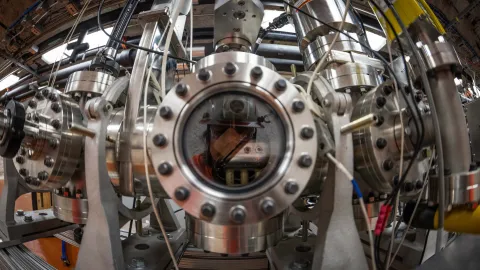
Photo by Stephen Kenny
-
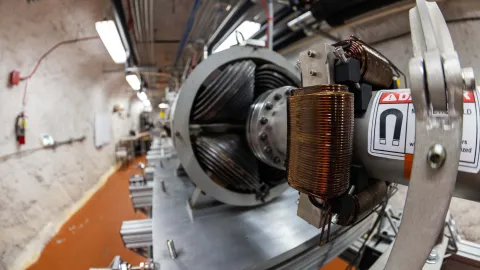
Photo by Stephen Kenny
-
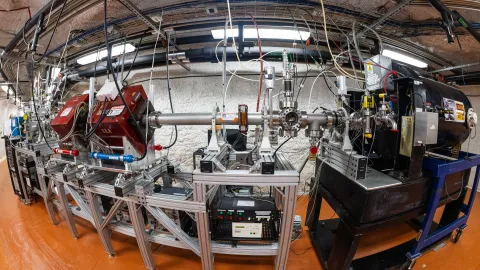
Photo by Stephen Kenny
-
Photo by Stephen Kenny
-
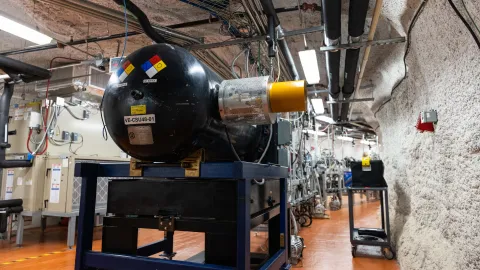
Photo by Stephen Kenny


The most recent data run at CASPAR is the culmination of the last two years of hard work by the experiment team, infrastructure team, laboratory custodians, shaft crews and underground maintenance crews at SURF.
“They've done a lot of work to get the Ross Campus ready for us. It’s taken a lot to get here. We’re grateful for this milestone.”


