
CO2 scrubbing microbes discovered in underground laboratory
Microbes found deep below the earth at the Sanford Underground Research Facility (SURF), a former gold mine in South Dakota, are being used to engineer enzymes that can pull CO2 gas directly from coal-fired power plant emissions.
You might not know it, but the hot water and rocks deep within the Earth are teeming with undiscovered life. Dr. Tanvi Govil is one of the biologists studying this new frontier of microbial life that thrives in extreme places.
Govil and a multidisciplinary team of researchers discovered a set of microbes living 4100-feet underground at SURF that essentially eat carbon dioxide gas (CO2) and turn it into rock at an incredibly fast rate. The initial research showed a vast improvement in the efficiency to sequester CO2 in storage underground—speeding up the process from years to a few weeks. Govil realized that instead of piping CO2underground, this technology enables direct removal of greenhouse gas emissions on site.
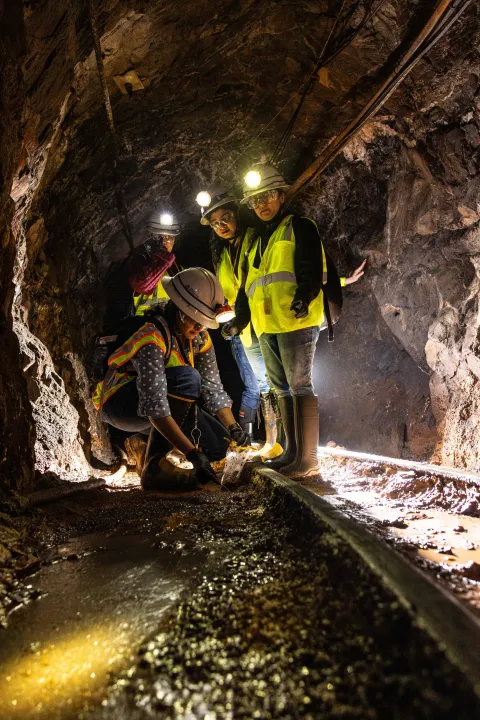
Dr. Tanvi Govil and her team, sampling for microbes on the 1700 Level of the ground at the Sanford Underground Research Facility.
Photo by Stephen Kenny
“The microbes we found at SURF help prove these biochemical reactions can be used to efficiently remove carbon from power-plant emissions. The discovery at SURF was the spark that started the whole thing,” said Govil, who is an assistant professor in the Karen M. Swindler Department of Chemical and Biological Engineering at South Dakota Mines.
Today, Govil is leading the effort to build a library of microbes from different parts of the world that have the right properties for carbon capture. Researchers are combining the best attributes from each microbe to engineer enzymes that can convert CO2 from coal-fired power plant emissions into calcium carbonate—a mineral that can later be sold as a concrete additive or for other industrial purposes.
“The lab experiments we have done are based on some sample emissions provided by local industries. We took flue gases, and even leftover coal ash, to lab test and validate that this technology will be able to work in the larger-scale industrial environment,” Govil said.
The idea involves taking a large tank of these carbon dioxide-capturing enzymes and bubbling emissions from a coal-fired power plant up through the enzyme solution. This process would remove the CO2 from the exhaust stream and convert it into a commercially viable biproduct.
Merle Symes is the CEO of CarbENZero, a company created by Govil and her team to speed this technology to market.
“There are heavy environmental pressures around the world to see this kind of climate solution put into place,” Symes said. “Many governments are very supportive of eliminating carbon emissions. We think we have a win-win solution.”
Scientists have known for a long time that microbes could be used to remove CO2 from emissions, but previous challenges include finding lifeforms that can survive the process.
“Factory and power-plant flue gases are pretty nasty,” Symes noted. “There are high temperatures, high pressure, sometimes there’s high acidity. This research found out that these unique microbes, which evolved in extreme environments, actually thrive on these things.”
Govil and Symes recently won the South Dakota Governor’s Giant Vision Business Plan competition with their patent-pending technology. They are continuing to refine the process and create enzymes robust enough to be shipped anywhere they are needed. The next step, Govil says, is pilot-scale testing. Her team is planning to build an enzyme-based CO2 scrubber that can sit on a truck bed, then bring it to a facility and hook it up to a stream of emissions.
“One of these mobile units will be able to take almost one ton of CO2 per day. This will allow us to demonstrate the technology to different partners and industries, validate the concept and business model,” Govil said.
The goal is to continue testing this year and launch enzyme production by 2027. “There’s some urgency in this, given the importance of what this technology could mean for humanity,” Symes said.
The carbon challenge is enormous—humanity currently emits more than 37 billion metric tons of CO2 per year. But Govil sees a path from the Black Hills of South Dakota to smokestacks around the world. The 2025 global market size for carbon capture and sequestration is valued at $4.51 billion. The market is projected to grow to $19.98 billion by 2034. If pilot testing goes as planned, Govil’s team aims to enter the marketplace by next year.
For a technology that started from samples taken 4,100 feet beneath the earth, inside a former gold mine turned laboratory in Lead, S.D., the timeline from discovery to market could be less than a decade.
-
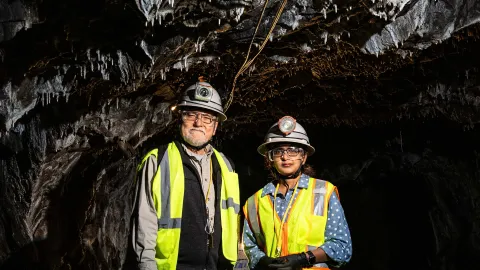
Dr. Tanvi Govil and Merle Symes on the 1700 Level of SURF during a sampling trip.
Photo by Stephen Kenny / SURF
-
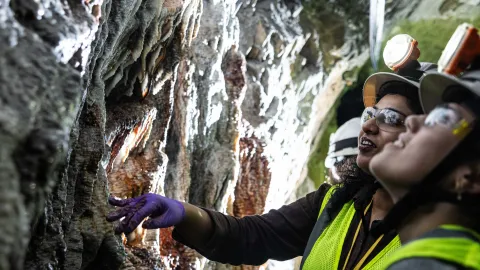
The South Dakota Mines team sampling for biology on the 1700 Level of SURF.
Photo by Stephen Kenny
-
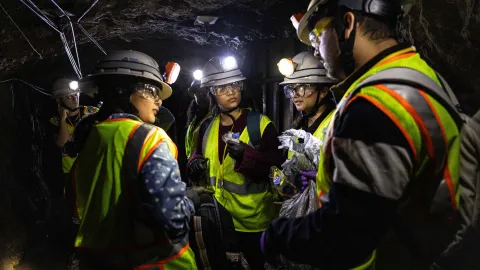
The South Dakota Mines team sampling for biology on the 1700 Level of SURF.
Photo by Stephen Kenny


