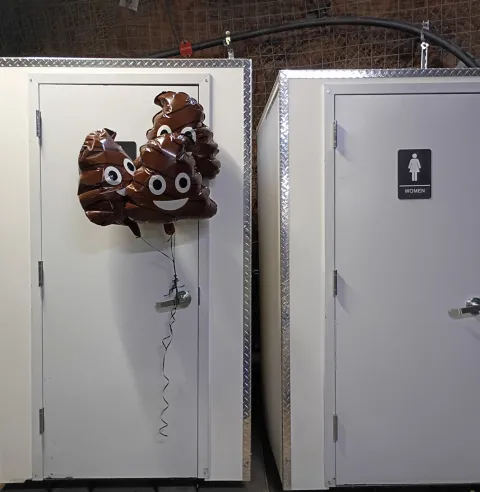
Engineering the amenities at America’s Underground Lab
Engineers and technicians at SURF have completed a new set of restrooms a mile below the surface. Building anything this far underground includes some unique challenges—made easier with the utilization of local companies and contractors.
You might not think about it, but if you are installing a world-class laboratory nearly a mile underground in a former gold mine that must accommodate 250 scientists, engineers and technicians daily—you need to provide some basic things—including restrooms.
But engineering even the simplest amenities 4850 feet underground is not as easy as it sounds.
Andrew Brosnahan, a professional engineer at SURF, led the engineering and design efforts for the new bathrooms at the 4850 Level in the Ross Campus.
“It's so different down here for installing anything. Being 4850 feet below the surface is the most challenging part of it,” Brosnahan said. He notes the limited space in the drifts (or tunnels), and the uneven rock walls pose additional hurdles when doing something simple like running water or electric lines. “Just unspooling all the pipe coils, and then adding in all the anchors, there’s a lot of work just to get all the piping installed. You just don't have nice square geometry to run things like you would in a building on the surface.”
Brosnahan adds that much of the work for this project was completed by technicians at SURF; their vast experience working at this unique site proved essential to the project’s success.
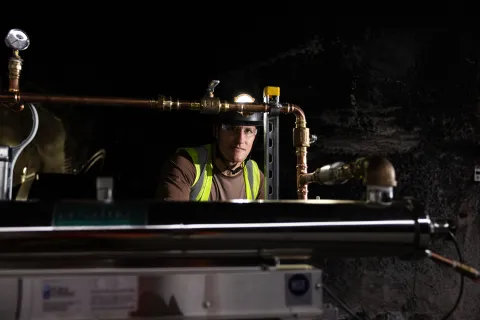
Andrew Brosnahan, a professional engineer at SURF, looks through a set of pipes on the 4850 Level.
Photo by Stephen Kenny
“The SDSTA electrical and operation crews were instrumental in helping on this project. The electrical group here at SURF did an amazing job completing this portion of the project,” he said.
According to Brosnahan, SURF was fortunate to partner with a local Rapid City company, B&T Manufacturing, which builds ready-made modular bathroom pods that are basically plug-and-play. The modular bathrooms also fit into the cage—the conveyance used to transport people and equipment from the surface underground—making it easy to deliver them a mile underground.
“The restrooms look great and we are thankful that B&T Manufacturing is so good to work with and has the capabilities to fabricate these custom restrooms with such proximity to SURF. Usually something like this would be procured somewhere halfway across the country,” he said.
Brosnahan also credits Harrison Western who helped with the installation and hook-up of the utilities to the pods.
“Harrison Western is great to work with. Their crews are always hardworking and are ready to work with us to overcome challenges on a project like this,” Brosnahan said.
Running water and electricity to the modular bathrooms was just one challenge; engineers and technicians also had to figure out how to treat the wastewater. On the surface this would be as simple as plumbing into a municipal or private septic system, but a mile underground, all water needs to be treated on-site before it’s discharged.
“This is the intake to our two-stage treatment system designed by Orenco,” Brosnahan said while placing his hand on a large tank sitting on the 4850 Level of the Ross Campus. “Stage 1 is the septic tank and is just like in your house, same kind of concept. The next tank is the second stage and provides the actual water treatment. This tank is a multiple-pass, packed-bed aerobic wastewater treatment system for processing residential strength wastewater. At a high level the incoming waste is cycled multiple times over filter curtains prior to being discharged.”
Brosnahan says the water is also run through an ultraviolet process before being sent as treated water into the deep pool at SURF. This water is eventually pumped to the surface by the SDSTA dewatering system to be treated again as mine wastewater before being sent down Gold Run Creek.
The underground amenities at SURF have come a long way since the historic mining days. Before the laboratory, miners had a toilet seat on a railcar tank they called the “Red Wagon.” Dan Regan, who worked for the former Homestake Mine and then SURF for more than 50 years, recalls the process.
“So, they'd place that Red Wagon on the rails strategically in an area, and when you needed the services you used it, flipped the lid. And of course, they wouldn't just ship them up when they were used once. They'd wait until they were near plumb-full. My goodness, it was a real task. No one wanted to be the person assigned to ship them up the shaft and replace them.”
The research in the vicinity of SURF’s 4850 Level Ross Campus includes the Deep Underground Neutrino Experiment. This and other experiments at SURF will require hundreds of personnel underground daily through this century; this makes flushing out the engineering challenges needed to upgrade the Red Wagon worth all the effort.
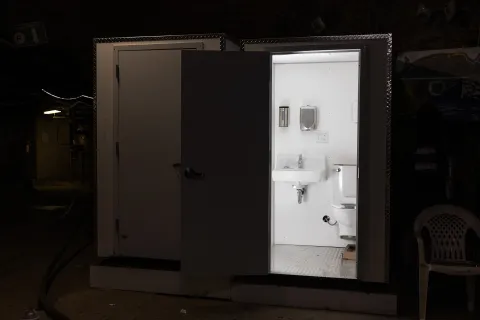
One of the new restroom pods at SURF provided by a local company, B&T Manufacturing, located on the 4850 Level Ross Campus.
Photo by Stephen Kenny