
LZ sees surprising result in the search for dark matter at SURF
The LUX-ZEPLIN experiment observed a particle interaction that could be interpreted as a signal from WIMPs, a dark matter candidate — but researchers will need more data to confirm.
This article was written by Lauren Biron at Lawrence Berkeley National Laboratory and first published here. Mike Ray completed this version of the article for SURF.
For the better part of a century, people have been trying to understand dark matter. This invisible substance makes up roughly 85% of the mass in the universe but has never been directly detected. Determining exactly what it is remains one of the biggest questions about our world.
Now, a new analysis from the LUX-ZEPLIN (LZ) experiment has recorded a single particle interaction that researchers have great difficulty explaining with known background signals from normal matter. The result does not yet meet the statistical threshold required to claim a discovery, but is the most compelling hint of dark matter reported by the experiment to date.
LZ is an international collaboration of 250 scientists and engineers from 39 institutions. The detector is managed by the U.S. Department of Energy’s Lawrence Berkeley National Laboratory (Berkeley Lab) and operates nearly one mile below ground at the Sanford Underground Research Facility (SURF) in South Dakota. The experiment uses 10 tonnes of ultrapure liquid xenon to search for dark matter and is optimized to look for WIMPs, or weakly interacting massive particles.
The results were presented in a scientific talk at the 2026 TeV Particle Astrophysics conference in Japan. The paper will be released on the online repository arXiv and submitted to the journal Physical Review Letters.
“We’re very intrigued to see this event in the data, in the region where we expect dark matter to show up and the competing backgrounds are very low,” said Rick Gaitskell, a professor at Brown University and the spokesperson for LZ. “With only one event, we don’t want to get ahead of ourselves. We are not claiming to have seen dark matter. But we have seen something interesting that we want to share with the scientific community for their input.”
The LZ collaboration studies experimental data in batches. In the new result, researchers analyzed 220 live days of data collected between March 2023 and April 2024. The collaboration had previously searched this dataset for faint signals from the simplest kinds of WIMP interactions. The new analysis searched for a broader range of possible WIMP interactions that could deposit more energy in the detector. LZ is particularly sensitive to such signals while also minimizing false positives.
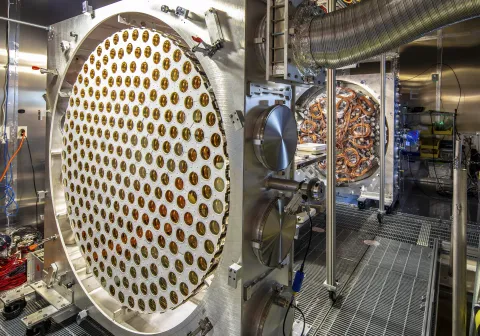
“This was a detailed study in a region we hadn’t explored within this dataset, and we spent months of additional effort to understand all the possible causes of background events,” said Sam Eriksen, a senior research associate at the University of Bristol in the U.K. and lead author of the study. “We understand our detector and the backgrounds so well that even a single outstanding event, like the one we found, is important. We expect dark matter events to be extremely rare, so only a handful could mark the first detection of WIMP dark matter.”
If the anomalous event was caused by dark matter, the WIMP that generated it would likely have a mass of at least 200 GeV/c2 (gigaelectronvolts), or more than 200 times the mass of a proton. It would also suggest a specific type of interaction between WIMPs and ordinary matter beyond the simplest model. The LZ results have not reached “5-sigma” significance, the statistical threshold considered a discovery in physics. The new analysis is 2.6 sigma, meaning there is approximately a 0.5% chance that the event could be explained by known backgrounds.
With additional data, researchers can test whether the finding continues to grow in significance or fades away. LZ has already accumulated the world's largest dark matter dataset and will continue to accrue WIMP search data at SURF, substantially improving their search statistics.
LZ is housed inside the Davis Campus, 4850 feet below the surface at SURF, in the same underground location where Raymond Davis won the 2002 Nobel Prize for solar neutrino research he initiated in the 1960s.
“We are proud to continue this long tradition of world-leading research at SURF,” said Mike Headley, the executive director of the South Dakota Science and Technology Authority and laboratory director at SURF. “We appreciate the strong partnership with the LZ Collaboration, and we look forward to ongoing dark matter research at SURF in the years to come.”
“Not only did LZ inherit the underground space where Ray Davis performed his pioneering neutrino work, the collaboration is doing the careful science needed to confirm our understanding of the Universe, similar to Davis’ own efforts. We look forward to analysis updates from LZ and the wider dark matter community and hope that SURF can continue to serve this exciting field by hosting leading dark matter detectors in the coming decades,” said Jaret Heise, director of science at SURF.
-

Alex Geffre, an engineering technician at SURF, at work on LZ.
Photo by Stephen Kenny
-
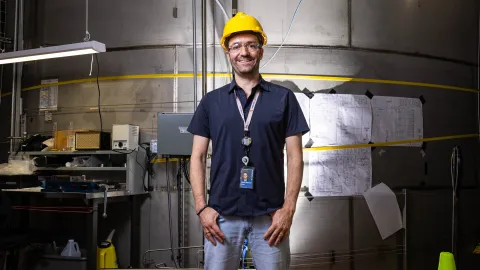
Dr. Markus Horn, a senior research scientist at SURF, stands in front of the LZ detector.
Photo by Stephen Kenny
-

Dr. Douglas Tiedt, a research scientist at SURF, at work on LZ inside the Davis Cavern.
Photo by Stephen Kenny
-
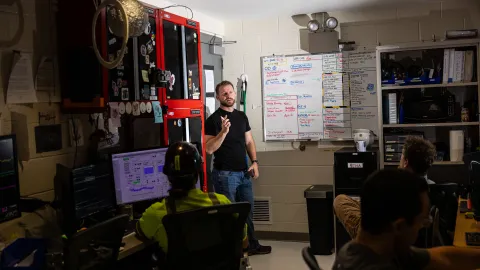
Gavin Cox, an experiment support scientist at SURF, confers with the team inside the LZ Control Room on the 4850 Level Davis Campus.
Photo by Stephen Kenny
-
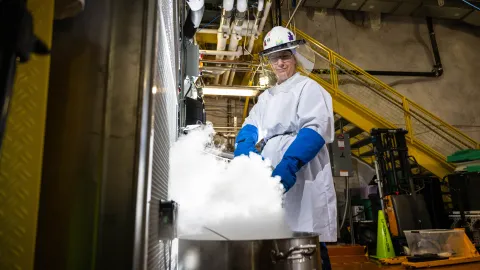
Julia Delgaudio, an experiment support scientist at SURF, works on the cryogenic system for LZ.
Photo by Stephen Kenny
-
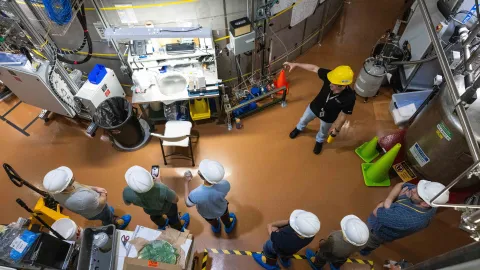
Markus Horn gives a tour of LZ to visiting scientists.
Photo by Stephen Kenny
-

Gavin Cox, a physicist and experiment support scientist at SURF, helps complete one of many hands-on tasks required to keep LZ operational.
Photo by Stephen Kenny
-
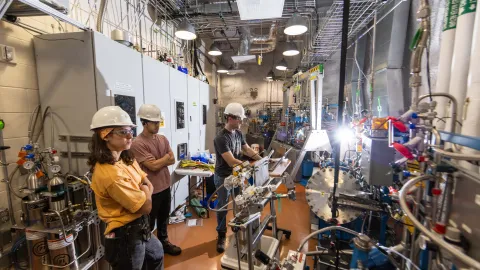
Scientists working on LZ are shown here alongside some of the equipment they maintain.
Photo by Stephen Kenny


LZ searches for dark matter by looking for signature flashes of light from energy deposited in the detector. The collaboration leverages multiple methods to prevent or account for particle interactions caused by normal matter. This includes the mile of rock that shields the detector from cosmic ray muons, a water tank and outer detectors that protect the central detector from background neutrons, and a suite of computational tools that disentangle particle interactions and reject dark matter mimics.
“Outlier events in the data are not unexpected, but they usually stand out as a background of some kind when you look at them deeper,” said Aaron Manalaysay, a physicist at Berkeley Lab and the chair of LZ's Institutional Board. “This is the first example in any experiment I've worked on of an outlier that appears valid in every way. Of course, we're still twisting our brains trying to think if there's a rare background mechanism we could've missed, but it's thrilling to wonder if this could be the first hint of a dark-matter observation.”
LZ is supported by the U.S. Department of Energy, Office of Science, Office of High Energy and Nuclear Physics, and the National Energy Research Scientific Computing Center, a DOE Office of Science user facility. LZ is also supported by the Science & Technology Facilities Council of the United Kingdom; the Portuguese Foundation for Science and Technology; the Swiss National Science Foundation; the Australian Research Council Centre of Excellence for Dark Matter Particle Physics; and the Institute for Basic Science, Korea. Thirty-nine institutions of higher education and advanced research provided support to LZ. The LZ collaboration acknowledges the assistance of the Sanford Underground Research Facility.


