
Sanford Underground Research Facility welcomes NEMESIS
SURF is home to a new experiment called NEMESIS. The project aims to better understand how background radiation can impact ultra-sensitive physics experiments—in the process, it might also aid the search for dark matter.
It seems appropriate that a deep underground laboratory should have an experiment called NEMESIS. The name conjures a science fiction trope, complete with a bespeckled villain in a lab coat surrounded by minions on a quest for world domination.
It may disappoint some that nothing happening at the Sanford Underground Research Facility (SURF) will lend itself to a sci-fi blockbuster.
In reality, the actual scientists who work at SURF find the NEMESIS experiment more compelling than any Hollywood science fiction.
NEutron MEasurementS In SURF (NEMESIS) is working to better characterize causes for bursts of neutrons—called high neutron multiplicity events. You can think of these events as a cue scattering pool balls across a table—neutron showers result when high-energy cosmic-ray muons passing through matter break one or more atomic nuclei. The experiment has been installed at the Black Hills State University Underground Campus (BHUC) on the 4850 Level of SURF.
These high neutron multiplicity events constitute a background that is not fully understood. They can cause a headache for physicists who work on ultra-sensitive experiments in underground labs like SURF, as they create false signals in the data. Knowing the neutron background can help scientists be more confident when conducting searches for extremely rare processes.
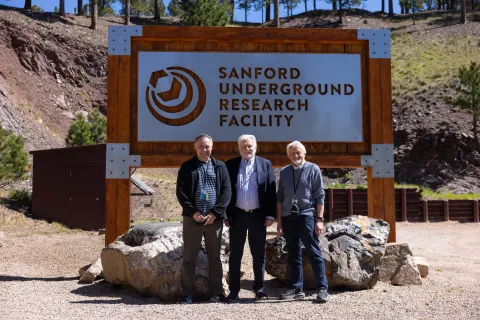
The NEMESIS collaboration arrives at SURF: Alexander Barzilov, Thomas Ward and Wladyslaw Trzaska.
Photo by Stephen Kenny
“We will certainly contribute to the whole underground research community by improving the knowledge on the neutron background,” said Thomas Ward, the chief scientist for TechSource Inc. and a lead researcher on NEMESIS.
At 82, Ward has been at this work for much of his life. He started as a postdoc at Brookhaven National Laboratory in the 1970’s with an office a few doors down from Ray Davis, who went on to win a Nobel Prize for his pioneering work at the site that is now SURF. For Ward, NEMESIS is a culmination of his own life’s work—it follows up on previous studies at the Pyhäsalmi mine in Finland, which showed some interesting results as published here in the journal Nuclear Physics. Ward says the research was stopped only when the host mine shut down and the underground lab space was to be flooded.
“We had an experimental station in Finland until December 2024, but it is now underwater, so we are very happy to be at SURF,” Ward said.
Previous experiments in Finland and elsewhere have shown some anomalies in these high neutron multiplicity events. Physicists often find anomalies interesting, because they can yield new science.
NEMESIS collaborators say that while the neutron background anomalies could come from high-energy cosmic rays streaming in from outer space or from radiation emitted naturally inside the Earth’s crust or even from some previously uncharacterized source, the anomalies could also come from another cause: dark matter.
“This experiment is probably the most definitive effort to examine these high neutron multiplicity events. It remains to be seen whether they're some sort of background that has been previously undefined or whether they are caused by dark matter, so I'm excited to be at SURF. Excited to be with my partners doing this experiment,” said Ward.
Wladyslaw Trzaska, a physicist at the University of Jyväskylä, Finland, is working alongside Ward on NEMESIS. He says SURF is the best place to probe this question.
“We are trying to make significant measurements of these events at various depths. The BHUC on the 4850 Level is a beautiful laboratory space with a nice clean room. We hope to put another station on the 1700 Level, closer to the surface,” Trzaska said.
Alexander Barzilov, a physicist at the University of Nevada, Las Vegas, is the principal investigator on NEMISIS. He is enthusiastic that future expansion with two NEMESIS detectors at different underground elevations, with different rates of cosmic ray muons, will provide the most robust data set on neutron anomalies.
“Our plans include running twin systems on both levels at the same time with multiple neutron detectors. This will allow us to see and confirm how the results change with depth,” said Barzilov.
An experiment like NEMESIS also benefits SURF’s ongoing mission to advance world class science and inspire learning across generations. This timelapse video shows the team installing the experiment on the 4850 Level BHUC. Brianna Mount, an associate professor of Physics at Black Hills State University, is the director of the Black Hills State University Underground Campus.
“NEMESIS brings an exciting new detection capability to the BHUC user facility,” Mount said. “It aligns well with one of the BHUC's goals of understanding rare event search backgrounds and might lead to surprising physics discoveries as well!”
Jaret Heise, the director of science at SURF, echoes Mount.
“We're very happy to welcome the NEMESIS experiment to SURF. NEMESIS expands the breadth of the SURF science program and is a great example of research that aims to take advantage of the unique attributes of our facility such as access to multiple depths,” Heise said.
NEMESIS researchers add that hunting for indirect evidence of dark matter with this experiment complements the ongoing world-leading dark matter search underway at SURF in LUX-ZEPLIN.
“Before anything is confirmed and accepted by a scientific community, you need multiple proofs. What we are doing is not a contradiction of what SURF’s LUX-ZEPLIN dark matter experiment is doing – quite the opposite. We are exploring a small range of what the dark matter particle mass might be as a very complementary effort to direct interaction searches,” said Trzaska.
Ward, Trzaska, and Barzilov describe the effort to indirectly detect dark matter with NEMESIS as a long shot. While this may be true, it’s also true that the history of science is punctuated by long shots that hit their target, and this makes NEMESIS worth all the effort.
And who knows, maybe a project like NEMESIS will inspire some future Hollywood writer to produce a big-screen blockbuster on the ongoing hunt for dark matter below the Black Hills of South Dakota.
Note: Reflecting NEMESIS’s history, the acronym’s meaning evolved over time. It stood for New Emma MEasurementS Including neutronS and NEutron MEasurementS In Subterranean locations. “With SURF firmly established as our new home, NEMESIS became NEutron MEasurementS In SURF. This is the final and appropriate name for the installation at BHUC, as well as for all our present and future activities there,” Trzaska said.


