
South Dakota Mines Scientists Lead Novel Measurement to Advance Proton Decay Searches
This news article, republished here from South Dakota Mines, showcases the value of local universities in advancing world-class research at America's Underground Lab.
Scientists from South Dakota Mines have led a groundbreaking international research effort that achieved the first-ever measurement of neutrino-induced kaon production on argon, a milestone that advances fundamental physics and strengthens the scientific foundation for future experiments based in South Dakota.
The result came after analyzing several years of data collected by the MicroBooNE detector, a large liquid argon time-projection-chamber neutrino experiment at the U.S. Department of Energy’s Fermilab National Accelerator Laboratory. “This is the first time in the world this rare process on an argon target has been measured,” said David Martinez Caicedo, Ph.D., associate professor of physics at Mines. “Before our measurement, information about this neutrino interaction on argon relied on models within neutrino event generators.”
Martinez Caicedo and Jairo Rodriguez, Ph.D., Mines post-doc, recently published their first-of-its-kind findings in Physical Review Letters, one of the world’s leading physics journals. While MicroBooNE is a large international collaboration, Mines served as the lead institution for this novel measurement, guiding the analysis from start to finish. Rodriguez led the analysis, which he completed as part of his doctoral research. In addition, former Mines postdoctoral researcher Arturo Fiorentini, Ph.D., also contributed during the early stages of the analysis development.
Neutrinos are extremely small, nearly massless particles that pass through ordinary matter by trillions every second. In the MicroBooNE experiment, scientists sent an intense beam of neutrinos from Fermilab into a detector filled with liquid argon. On rare occasions, a neutrino collides with an argon atom and produces a short-lived particle known as a kaon, or K meson. Until now, the specific interaction had never been directly measured in an argon-based detector. The study examined data representing three years of detector operation.
Measuring this type of interaction was no easy task.
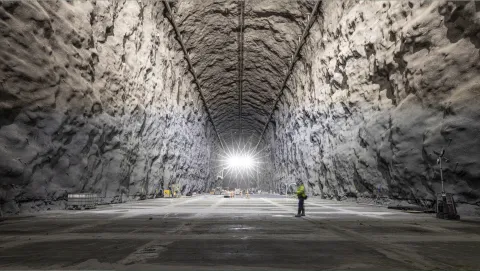
Photo by Matthew Kapust
“Out of hundreds of thousands of neutrino interactions over several years, we identified just 10 candidate events,” Rodriguez said. “From those, we determined eight out of 10 to be kaon candidates in the detector, and we were able to see them. That may sound small, but in particle physics, this is a major achievement.”
The Mines research team relied on the MicroBooNE detector’s ultra-high-resolution imaging, which enables scientists to see particle tracks with millimeter precision. Rodriguez added they also used advanced machine learning tools to separate kaon signal candidates from the background.
Beyond studying this rare interaction, the measurement plays a critical role in one of physics’ biggest questions: the search for proton decay. Some leading theories predict that protons, one of the fundamental building blocks of matter, are unstable and may decay over extremely long timescales, producing kaons in the process. Detecting proton decay would transform scientists’ understanding of the universe.
The measurement is significant for the Deep Underground Neutrino Experiment (DUNE), one of the world’s largest physics projects, housed at the Sanford Underground Research Facility (SURF) in Lead, South Dakota. MicroBooNE was designed as a smaller prototype for DUNE, using the same liquid argon technology only on a smaller scale.
“We were happy to play a leadership role in demonstrating that the Liquid Argon Time Projection Chambers technology allows the identification of this rare interaction,” Rodriguez said. “If we can detect these rare processes in MicroBooNE, we are very eager to understand the potential to study them with much greater precision when DUNE begins collecting data.”
Once online, DUNE is expected to operate for decades, collecting vastly more data than MicroBooNE and enabling scientists to study rare interactions in greater detail and with much higher accuracy. The Mines milestone provides experimental input that will inform DUNE’s scientific program about these interactions.
“This milestone measurement lays the groundwork for future studies of kaon production on argon,” said Martinez Caicedo. “As we sharpen our understanding of this process, scientists will be able to make more accurate background predictions for nucleon decay searches at DUNE and use real data to fine-tune the neutrino models.”


