SURF completes DUNE steel beam test lift
Photos by Matthew Kapust
A crew of technicians, riggers, hoist operators, and engineers at the Sanford Underground Research Facility (SURF) have successfully completed the first test lift of one of the long steel beams that will be used to construct the far detector cryostats for the Deep Underground Neutrino Experiment (DUNE).
The 43 foot-long beam weighed more than 15,890 pounds and was safely moved into the Ross Headframe on a set of rails, attached to the winch and rigging inside the specially constructed cage, and lifted into place.
“This project showcases the South Dakota Science and Technology Authority (SDSTA) team at SURF doing what they do best, safely and successfully completing a task necessary to support the next phase of DUNE,” said Wendy Straub, Chief Operating Officer at SURF. “This is the culmination of countless meetings with our partners at Fermilab involving planning, engineering, and hazard elimination, associated with transporting heavy unusual loads on the new skip conveyance. It was awesome to see all the teams come together and execute the test successfully.”
The test lift of this massive beam took about 18 minutes. This is a process that will be repeated many times over in the coming months. This beam is one of 2100 structural components that will be transported underground by SURF in support of DUNE.
“This test brings together extensive planning: the cryostat steel delivered by CERN, the utilization of new infrastructure such as the lifting adapter, the new skip conveyance as well as recent modifications to the Ross headframe including raising the door and new rails,” said Jolie Macier, Fermilab’s far detector and cryogenics project manager for LBNF/DUNE-US. “Further, our teams worked together to execute this lift safely, efficiently and smartly, such that we can repeat such lifts hundreds of times to support the full range of DUNE installation activities.”
These photos tell the story best:


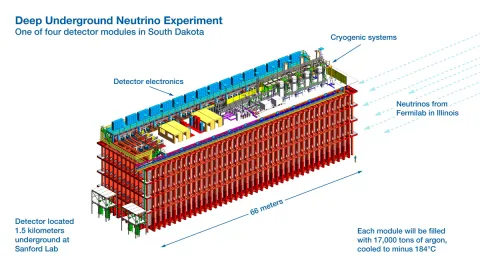
Once assembled with the other 2,500 tons of steel, this beam will help form a structure measuring 216 feet long, 62 feet wide and 60 feet high. After the internal insulating material is installed, the integrated structure will support and house a particle detector that will be filled with 17,000 tons of liquid argon cooled to minus 184 degrees Celsius.
DUNE is hosted by the U.S. Department of Energy’s Fermilab. The massive cryostat detectors will be built by CERN 4850 feet underground. In total 1,500 scientists and engineers from over 35 countries are collaborating on this project.