
Rachel Berg, 2026 SURF Artist in Residence, makes a Homecoming to Lead
Rachel Berg spent part of her childhood in Lead and is returning as the 2026 Artist in Residence at SURF. Berg is an interdisciplinary Mnicoujou Lakota artist whose work is rooted in observation of the natural world and Lakota values.
Rachel Olivia Berg grew up in the shadow of the headframes that dominate the skyline of Lead.
She lived in the northern Black Hills as a child and spent her formative years in Lead-Deadwood, Central City, and her hometown of Eagle Butte—the seat of the Cheyenne River Sioux Tribe, where she was born.
In a sense, Berg grew up alongside the unfolding history of the Sanford Underground Research Facility (SURF).
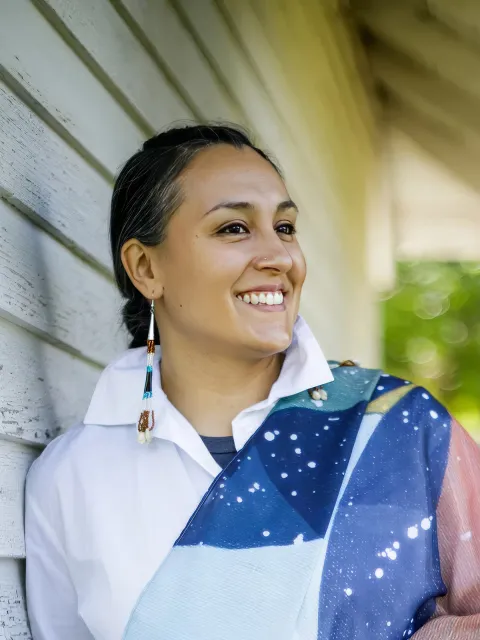
“When the mine became a research facility it was so exciting to me to think about the kind of science happening underground right here where I grew up,” Berg said.
Today, Berg lives in upstate New York. The 2026 Artist in Residence (AiR) program at SURF will bring her full circle, back to the Black Hills.
“Everything about the Sanford Underground Research Facility’s unique artist residency program, resources, and collaborative research environment aligns with my artistic practice and current trajectory of inquiry,” Berg said. “The questions being asked at SURF: the nature of the universe, questions of where and why we exist, these really, deeply important physical questions, are all things that, as an artist, I think about all the time.”
Berg earned a bachelor’s degree in visual arts and American studies at Princeton University and later completed a master’s degree in art and art education at Columbia University Teachers College. Her career spans more than 20 years and includes gallery exhibitions, awards, public lectures and workshops, as well as community art projects and commercial art commissions in buildings and institutions across North America.
“My work emerges from observation of the natural world, Lakota values, and Indigenous ways of knowing,” Berg said. “Through these lenses, I have investigated human relationships with the environment, examined natural cycles, and drawn on creation stories and star knowledge of the Oceti Sakowin (Seven Council Fires) to open conversations about divergent cultural understandings of ‘being’ and the worldviews that shape how communities live, remember, and imagine the future.”
Berg’s artwork spans a wide range of disciplines, including mural mosaics in resin and plaster, cyanotype tapestries, paintings, graphic design, and immersive installations in hotels and hospitals, as well as in public art projects such as Listening to Inyan in Jackson Hole, Wyoming. The year-long exterior installation was composed of 365 clay stones suspended from strings, each wrapped in a cyanotype print of a living being within the Greater Yellowstone Ecosystem. The piece illustrates the risks pollution poses to the local ecosystem and highlights the microorganisms within the Snake River Aquifer that help purify the waterway.
Lakota concepts such as Inyan — the primordial spirit of rock and a core element of Lakota creation stories and spirituality — are themes Berg hopes to explore further during her residency at SURF.
“I am very much interested in continuing my conversations with Inyan and will use my time at SURF to go deeper, literally, into the heart of Inyan to gain a new perspective on interpretations of the Lakota symbols, star knowledge, and the search for congruencies between understanding dark matter, life underground, and the manifestations of the compassionate ‘creator being’ Inyan,” she said.
One of the goals of the SURF AiR program is to bridge science and art. Berg plans to explore parallels between Lakota worldviews and scientific exploration, noting that the distance between the two may not be as wide as one might think.
“The more I inquire, the more I realize that there are just so many connections between Lakota cultural practices, and ways of thinking that are in line with contemporary science,” Berg said. “So, that intersection is just incredibly interesting to me. And I think it has potential to connect, mind, body, spirit, into new ways of knowing.”
SURF occupies a place sacred to multiple nations of indigenous people. This long history exists alongside 130 years of labor and toil by generations of gold miners who made way for the emerging history of world-class science on this site.
Gina Gibson, a professor at Black Hills State University and the inaugural SURF AiR, now serves as the program’s coordinator. She is excited to see what Berg will add to the understanding of this story.
“Rachel Berg’s artwork is not only beautiful but intellectually stimulating. The work is layered with deep meaning. I am excited to see what she creates as the 2026 SURF AiR,” Gibson said.
Inspiring new ways of thinking about science is a core goal of the SURF AiR program, now in its seventh year. Artists can illuminate new ideas and offer new perspectives that are valuable in SURF’s mission to advance world-class science and inspire learning across generations.
The SURF AiR program is modeled after artist residency programs offered by government, science and industry organizations, including the National Park Service, CERN and Fermilab. Learn more about Rachel Berg’s art here.


