
2023 Davis-Bahcall Scholar, Connor Matthies, designs experiment to test innovative cooling jets
This article, by South Dakota State University, highlights the research of Connor Matthies, a 2023 Davis-Bahcall Scholar at SURF.
“Cool your jets” might have been advice your mother gave you when you got a little hot under the collar.
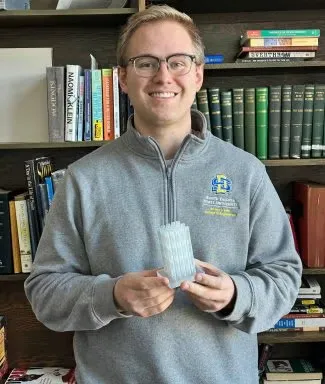
Connor Matthies holds a scale model of the jet array that will be used in his Future Innovator of America project. Matthies is testing a couple different designs for using jets of air to cool a heated surface.
Photo courtesy of SDSU
For Connor Matthies, it’s a science project — in a sense, anyway. Matthies, a senior mechanical engineering major from Hartford, is one of eight Future Innovators of America this school year.
This is the fourth class of Future Innovators of America, which is chosen by the Jerome J. Lohr College of Engineering at South Dakota State University. Recipients are awarded $5,000 with $4,500 as a stipend and $500 to cover the cost of lab supplies or travel to disseminate the results of their project.
The fellowships were created to provide unique research opportunities for undergraduate students in the college. Any student is eligible to apply as long as they are attending full time and have a GPA of 3.0 or higher. Application deadline was Nov. 5.
Each student worked with a potential project mentor, who must be a faculty or research staff member, to develop and submit a research plan that entails learning by doing.
Matthies’ project, conducted under the supervision of associate professor Gregory Michna, is “Experimental and Numerical Investigation of Swirling Impinging Jet Arrays with Novel Geometries.” The simple explanation is Matthies is testing a couple different designs for using jets of air to cool a heated surface.
This is a common practice in industry, particularly in the textile and aerospace industries as well as for electrical component manufacturers and high-performance data centers.
Creating a unique experiment
What makes Matthies’ research unique is he is adding a swirl to the array of 25 jets blowing room-temperature air on a sheet of heated stainless steel.
An array of jets adds uniformity to the cooling process. Matthies’ experimentation will look at several variables — swirl direction, flow rates and the amount of swirl. The number of jets and jet size will be fixed.
In one test, the air will all swirl one direction, either clockwise or counterclockwise. In the other test, a checkerboard design will be used — the air flows clockwise from one jet while in the adjoining jet the flow is counterclockwise.
Benefits from summer REU program
Matthies started his project with literature review in spring 2025. He took summer off, kind of. He participated in a Research Experience for Undergraduates program at the University of Central Florida, where the focus was “Advanced Technologies for Hypersonic Propulsive, Energetic and Reusable Platforms.”
Part of that hands-on research training involved simulating carbon dioxide flow and temperature profiles.Certainly a bingo for his Future Innovator project. “That really helped prepare me for my FIA research,” Matthies said. He already had an interest in computational fluid dynamics and heat transfer. The 10-week REU program gave him a chance to pursue it more deeply.
Michna noted, “His CFD skills had improved. More importantly, he came back with a much better understanding of the research endeavor and of the work necessary to make new discoveries. He hit the ground running upon returning to Brookings in August.”
Lessons learned from FIA project
Unlike a class assignment or an industry-directed project, Matthies’ Future Innovator project gave him great flexibility in how to structure it.
That was both the most challenging and most enjoyable aspect, he said. “Dr. Michna is there as an adviser and to course-correct, but I have the responsibility of the whole project. The design of an experiment is something I’ve never had to deal with. I have to be able to think of every aspect and then solve all the problems.
“The design decisions are novel for both of us, so I’ve had to learn the processes myself and be able to defend it,” and when that happens there is a lot of satisfaction, he said.
And a lot can be learned when the processes don’t go well.
For example, Matthies initially tried using his home 3D printer to create the five-by-five array of jets. That was a short-lived effort. Next try was using a 3D resin printer in associate professor Saikat Basu’s mechanical engineering lab. Then the model needed to be reprinted to strengthen the base to keep it from tearing away from the printer.
The 10-hour process of printing the jets is now in the past tense. Next up is creating a polycarbonate shroud from which a fan will blow air through the tubes to the array of jets. He expects to be able to run the heat transfer tests this spring and wrap up his report in time for graduation May 9.
Senior design project: Building USA drone
It will be a busy spring for Matthies, who freely admits, “I don’t have a lot of free time.”
In addition to 10 hours per week with his Future Innovators project, Matthies is president of the college’s Joint Engineering Council, is active in the SDSU Robotics Club, has a senior design project to make a USA-made drone, and is a member of a mechanical engineering class building a drone adept at lifting.
The senior design project, in which he is teamed with mechanical engineering classmates Ryan Risacher, Dayton Downing and Braxton Hahn, is being conducted under the supervision of Todd Letcher, an associate professor in mechanical engineering. The South Dakota Space Grant Consortium-sponsored project is in response to a December ban that the U.S. government placed on federal agencies wanting to buy drones.
They can no longer be purchased from Chinese firms, and China had been the leader in drone manufacturing, Matthies explained.
The students intend to have a 5-pound drone built in time for the Engineering Expo at SDSU April 28. But the end goal is to see if USA-made drones could be a viable business, Matthies said.
Competing for a $6.5 million prize
The other drone is part of the DARPA (Defense Advanced Research Projects Agency) Challenge, a federal contest with a $6.5 million prize that is primarily attracting industry contestants, Matthies said. The objective is to build a drone that can lift four times its weight and fly a course, he said.
Concept submission deadline is May 1 with finalists invited to test their drones in June.
Matthies is one of 12 students working on the project, which is a class taught by Letcher. “It felt like a good fit since we’re already designing a drone,” Matthies said. They have their work cut out for them. Students were still brainstorming designs as of Jan. 20.
But don’t discount the group’s chances. Matthies’ higher education experience has been a charmed existence, beginning with selection as a Davis-Bahcall Scholar after graduating from West Central High School. That program is operated by the Sanford Underground Research Facility for incoming college freshmen and sophomores.
He spent two semesters with The Pride of the Dakotas Marching Band. It coincided with the football team’s national championships and the band’s trip to the Macy’s Thanksgiving Day Parade.
“It’s been a whirlwind and a tremendous experience. I wouldn’t change it for the world,” Matthies said of his college years.
After graduation May 9, he plans to work in either the aerospace or heat transfer industries.


