
Teacher Feature: Ally Bowers, inspiring students and connecting educators
Ally Bowers has an established history of motivating both students and teachers to find their passion for all things STEM.
Bowers is a high school science teacher in rural South Dakota and the president of the South Dakota Science Teaching Association. Bowers has also taken part in SURF’s teacher professional development opportunities and utilized SURF’s classroom resources throughout her career.
At more than 1600 square miles, South Dakota’s Lyman County is bigger than the state of Rhode Island. But unlike Rhode Island, Lyman County’s total population tops just over 3700 people.
Many Lyman Country residents would not have it any other way. South Dakotans frequently take pride in the relative solitude and strong communities that can be found in the gorgeous and wide-open rolling prairie landscapes in this Great Plains state.
At the same time, the sparse population in this part of the country can pose unique challenges for educators. Ally Bowers is the lone science teacher at Lyman High School—and she does it all.
“I teach everything—biology, chemistry, physical science, Earth science, anatomy. The only thing I've never taught is physics,” Bowers said.
Bowers also serves as the president of the South Dakota Science Teaching Association. The organization fosters networking among teachers and hosts a gathering of STEM Educators each February in Huron, SD. (Registration is now open for the 2026 South Dakota STEM ED Conference.) Bowers says the community created by the state’s science teaching association is vital for those who work in rural schools.
“I am really passionate about connecting with other educators because those connections are so important for our smaller districts where teachers do not have other colleagues to collaborate with. They may have five or six classes that they teach, and they need resources to provide high-quality instruction,” Bowers said.
Make no mistake, rural science teachers like Bowers provide high-quality instruction. This is evident in her own students—one of them, Sam Schleich is a former Davis-Bahcall Scholar turned National Science Foundation graduate research fellow who is now working toward his doctorate in physics at Indiana University Bloomington.
“Ally was—and still is—more than just a teacher, but a friend, too. She cares about every individual student of hers and will stop at nothing to help them succeed,” said Schleich. “Ally pushed me harder than any other teacher of mine, inspiring me and providing me the connections I needed to kickstart my career in physics. Without her, I’m not sure I would have even known about Davis-Bahcall or any other opportunities for young scientists like myself. I credit her with being one of the most influential people in my life and I am grateful that I had a teacher like Ally who is equally passionate about science as I am.”
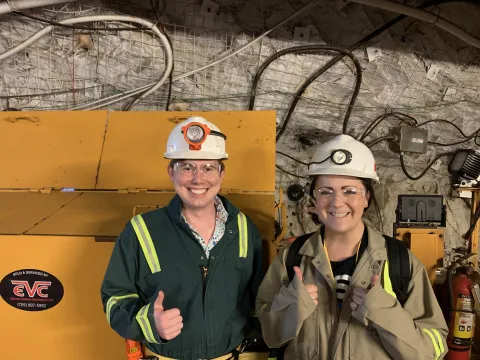
Sam Schleich and Ally Bowers pose together on the 4850 Level of SURF.
Bowers also heaps praise on Schleich for his incredible aptitude, hard work, and success in STEM; she takes additional pride in all her former students for their own successes. “I have several students who are now educators, which makes me so very happy,” Bowers said.
Miranda Hanson is also one of Bowers' former students who now teaches middle school science in Mitchell, SD.
“Ms. Bowers was more than just a science teacher. She was a cheerleader, a mentor, and a constant source of encouragement,” said Hanson. “She never let me give up, even when I struggled, and she pushed me to believe I could do more than I ever imagined. Her passion for teaching and her belief in her students changed my life. Because of her, I am now a science teacher, hoping to inspire others the way she inspired me.”
Bowers credits the professional development opportunities, along with the classroom resources and support provided by the education and outreach team at the Sanford Underground Research Facility (SURF), for helping her inspire students and advance her own success.
“I really love science as is, but science pedagogy is almost more interesting to me. How do we get kids excited about science? How do I get them to do the work of figuring out questions on their own, rather than just me lecturing all day about science to them,” Bowers said.
Bowers completed her master’s degree on science identity in the classroom, focusing on the teacher’s role in helping students see themselves as scientists. Seeing that spark in a student, when the light goes on and they get excited about the subject, provides fuel for the fire.
“It's huge when you see that spark start to develop in kids, and you see kids that normally would have said, like, ‘Oh, I'm not a science person. I don't really do well in science.’ And then you see them become a leader in their group, while asking great scientific questions, and feeling safe and confident in themselves,” said Bowers.
Any of the students that Bowers helps to find safety and confidence in STEM thinking will find great value in these critical skills—regardless of the future career they choose. Some will even take the spark of learning they found in a small rural school, ignited by an enthusiastic teacher, and grow into breakthrough leaders in their own fields.
After all, it was Ernest Lawrence, the inventor of the cyclotron, who went on to win a Nobel Prize in Physics for his work, after graduating from a rural school in a small South Dakota town.


